
Elinor Ostrom’s central achievement is dismantling decades of rigid economic theory to show that communities can successfully manage shared resources without relying on centralized government control or absolute privatization.
1. The Core Arguments
-
Simplified models like Tragedy of the Commons and Prisoner’s Dilemma are not enough: These traditional models assume humans are trapped—unable to communicate, unable to build trust, and doomed to overuse a resource. Ostrom argues these are narrow, special scenarios. In reality, humans can communicate, negotiate, and change the rules of the game.
-
State and markets are not the only two options: Historically, policymakers believed you had only two options to save a resource: bring in a centralized government regulator (State) or chop the resource up into private property (Market). Ostrom argues both rely on unrealistic assumptions:
-
The State assumes “Perfect Knowledge”: It assumes a distant government regulator knows exactly how a local ecosystem works, what the optimal limit is, and who is breaking the rules. In reality, distant regulators lack local knowledge, leading to clumsy rules that fail to match the ecology.
-
The Market assumes “Perfect Fences”: It assumes any resource can be neatly chopped into private pieces. But you cannot easily put a private fence around a moving, “fugitive” resource like swimming fish in an ocean or a massive underground water basin.
-
-
Not “Romantic Localism”: Ostrom isn’t wearing rose-colored glasses. She doesn’t believe local communities always win. They fail all the time due to deep inequalities, terrible local knowledge, or outside political interference. Her goal is to diagnose the exact structural reasons why they succeed or fail.
2. Key Terms
-
Common-Pool Resource (CPR): A shared system (like a lake, forest, or pasture) where it is hard to keep people out, and one person’s use leaves less for everyone else. Note: “Common-pool” describes the physical resource, not who legally owns it.
-
System Resource vs. Resource Units: The system is the stock (the lake itself); the units are what you take out (the fish). You have to maintain the system to keep extracting units.
-
Appropriator: Anyone taking units out of the resource (e.g., a fisher pulling out fish, a farmer pumping water).
-
Provider: The person or group who arranges for the resource system to be maintained (e.g., an irrigation board that collects fees or organizes labor).
-
Producer: The person who actually constructs, repairs, or maintains the resource (e.g., the worker physically patching the dam). Note: Appropriators, Providers, and Producers can all be the exact same people.
-
Appropriation vs. Provision Problems:
-
Appropriation Problem: Figuring out who gets to take what, when, and how without exhausting the supply (allocating the flow).
-
Provision Problem: Figuring out who has to do the physical work or pay the money to maintain the system (maintaining the stock). A community might solve one but fail at the other.
-
-
Working Rules: The actual rules people follow and enforce on the ground, which often look completely different from official government statutes.
-
Institution vs. Organization vs. Organizing: An Institution is the durable set of rules. An Organization is the body of people. Organizing is the active process of coordinating.
-
Transformation Costs: The upfront resources (time, money, lawyers, political capital, arguments) spent negotiating and creating new rules.
-
Discount Rate: How much a community values the future compared to the present. A low discount rate means they expect to be there for generations, so they value the future highly. A high discount rate means they want to extract maximum profit right now and leave.
3. The 8 Design Principles
Ostrom looked at commons that survived for centuries and found they all broadly shared these eight structural features:
-
Clear Boundaries: You must know exactly who is allowed to use the resource and where the physical limits of the resource are.
- Without boundaries, local users have no incentive to conserve. If a community sacrifices to save a forest, but outsiders can freely come chop down the trees, the locals’ investment is wasted. Boundaries turn an open-access free-for-all into a defined group capable of building trust.
-
Locally Fitted Rules (Congruence & Proportionality): The rules must make sense for the local ecology. Furthermore, the benefits you get out of the system should be proportional to the work or money you put into it.
- A uniform national law rarely fits the specific realities of a local micro-climate. Additionally, the proportionality mechanism ensures perceived fairness. If users feel they are getting a fair return on their effort, they are much more likely to voluntarily comply.
-
Collective-Choice: The people who are affected by the rules get a say in modifying them.
- This ensures the rules utilize actual, on-the-ground local knowledge rather than distant theory. It also means that when the environment or economy inevitably changes, the community can quickly adapt their rules without waiting for a slow bureaucratic state to respond.
-
Monitoring: The people checking for rule-breakers are either the users themselves or someone directly accountable to the users.
- In traditional economic theories, monitoring fails because nobody wants to do the unpaid work of acting as the police. But Ostrom found that good local rules make monitoring a cheap, natural byproduct of everyday work (e.g., an irrigation rotation forces Farmer B to wait for Farmer A to finish; Farmer B naturally watches Farmer A to ensure he doesn’t take too much water). This provides the assurance everyone needs to keep cooperating.
-
Graduated Sanctions: Punishments aren’t one-size-fits-all. They start as a slap on the wrist for honest mistakes and escalate for repeated, intentional cheating.
- Humans make honest mistakes. An immediate, catastrophic punishment for a small error destroys social trust and causes the system to be viewed as illegitimate. A small initial penalty corrects the behavior while preserving the community fabric, but the threat of severe escalation stops persistent free-riders.
-
Low-Cost Conflict Resolution: There are cheap, fast, and accessible ways to settle conflicts before they tear the community apart.
- Real-world rules are always slightly ambiguous. If resolving a minor water dispute requires a ten-year, expensive court battle, honest disagreements will fester into permanent resentment, destroying trust and causing the whole system of cooperation to collapse.
-
Right to Organize: Outside authorities (like the federal government) must respect the community’s right to make and enforce its own rules.
- If a wealthy cheater can simply bypass the local community by appealing to a sympathetic higher political authority, the local rules lose all credibility. Local commitments only hold weight if the state refuses to act as an escape hatch for rule-breakers.
-
Nested Enterprises: For massive resources, governance is layered. Small local groups handle local issues, feeding into larger regional bodies that handle system-wide problems.
- You cannot manage a giant river basin with a single face-to-face town hall, but a single massive bureaucracy lacks local nuance. Nesting bridges the gap: it allows small, localized units to maintain face-to-face trust, while larger umbrella organizations handle system-wide issues.
4. Case Studies
A. The Long-Enduring Commons (Centuries of Success)
These communities successfully implemented the 8 design principles to solve the problems of commitment and monitoring over hundreds of years.
| Location & Resource | How the Principles Ensured Success |
|---|---|
| Törbel, Switzerland(Alpine Pastures/Forests) | To solve the problem of overgrazing, the village strictly bounded the commons to citizens only. They achieved ecological congruence through a highly verifiable “wintering” rule: no citizen could send more cows to the summer alpine pasture than they could feed through the winter using their own private land. This easily observable metric prevented cheating. Users maintained collective choice through annual association meetings to vote on rules and designate labor. Monitoring was actively incentivized (the chief official kept part of the fines he levied), and sanctions were graduated to preserve community ties. |
| Japanese Villages(Hirano, Nagaike, Yamanoka) | The villages strictly limited access rights to established household units, rather than individuals, to prevent families from splitting up to claim more resources. To solve the problem of who monitors the monitors, the villages employed local “detectives” on horseback. Rather than relying on altruism, the monitors were highly incentivized by being allowed to keep the cash and sake fines they collected from rule-breakers. Crucially, they utilized graduated sanctions with great flexibility: during the severe economic depression of the 1930s, monitors deliberately ignored minor infractions to preserve the community fabric and livelihoods, proving that robust institutions adapt rather than blindly enforcing rules to the point of collapse. |
| Spanish Huertas(Valencia, Murcia, Alicante) | These complex irrigation communities survived for over 500 years by tightly bounding water rights to specific lands. Their rules were perfectly congruent with the local micro-ecologies (e.g., rigidly timed water slots in the severely dry Murcia, versus volume-based sequential turns in Valencia). Irrigators directly elected their own syndics (collective choice). Because water turns were sequential, Farmer B naturally and cheaply monitored Farmer A to ensure his own water wasn’t stolen. The linchpin of their success was Principle 6: the weekly, public Water Courts (like the Tribunal de las Aguas) provided rapid, cheap, and legitimate conflict resolution before disputes could fester into violence. |
| Philippine Zanjeras(Bacarra-Vintar Irrigation) | These federated irrigation systems achieved perfect proportionality between effort and reward. An “atar” (a membership share) combined a vote, rights to water, and strict obligations to provide physically grueling labor to repair brush dams. To ensure everyone cared about the entire system, a farmer’s land was physically split into parcels located at the head, middle, and tail of the canal. This ingenious rule ensured that upstream farmers couldn’t simply take their water and abandon the system; they had to maintain the flow all the way to the tail to water their own bottom parcels. Component zanjeras were beautifully nested into a larger federation to manage the main river diversion. |
I also tried to generate some LLM comics via gpt-image-2, which wasn’t terrible:
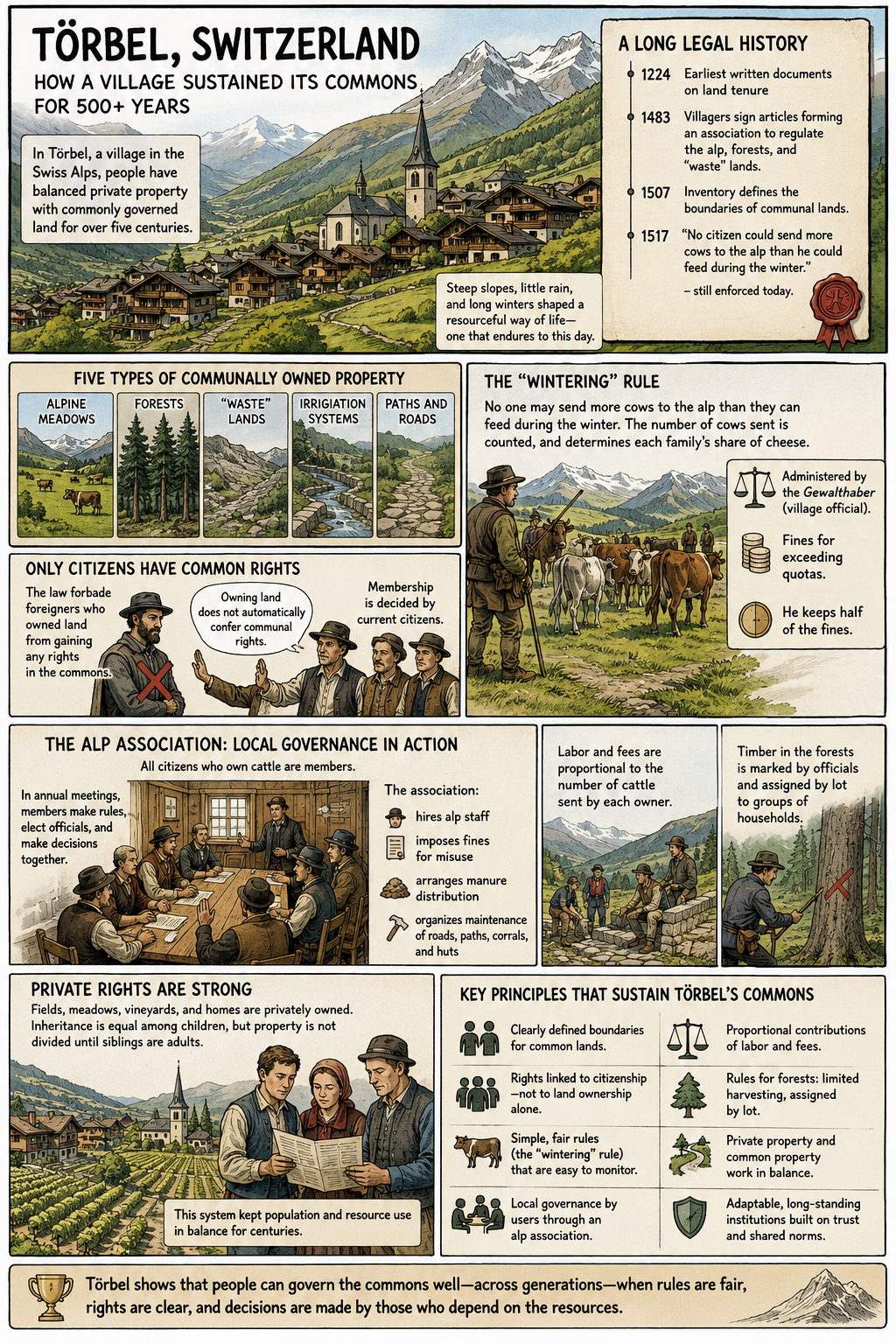
Törbel, Switzerland: clear boundaries, the wintering rule, proportional obligations, and local collective choice.
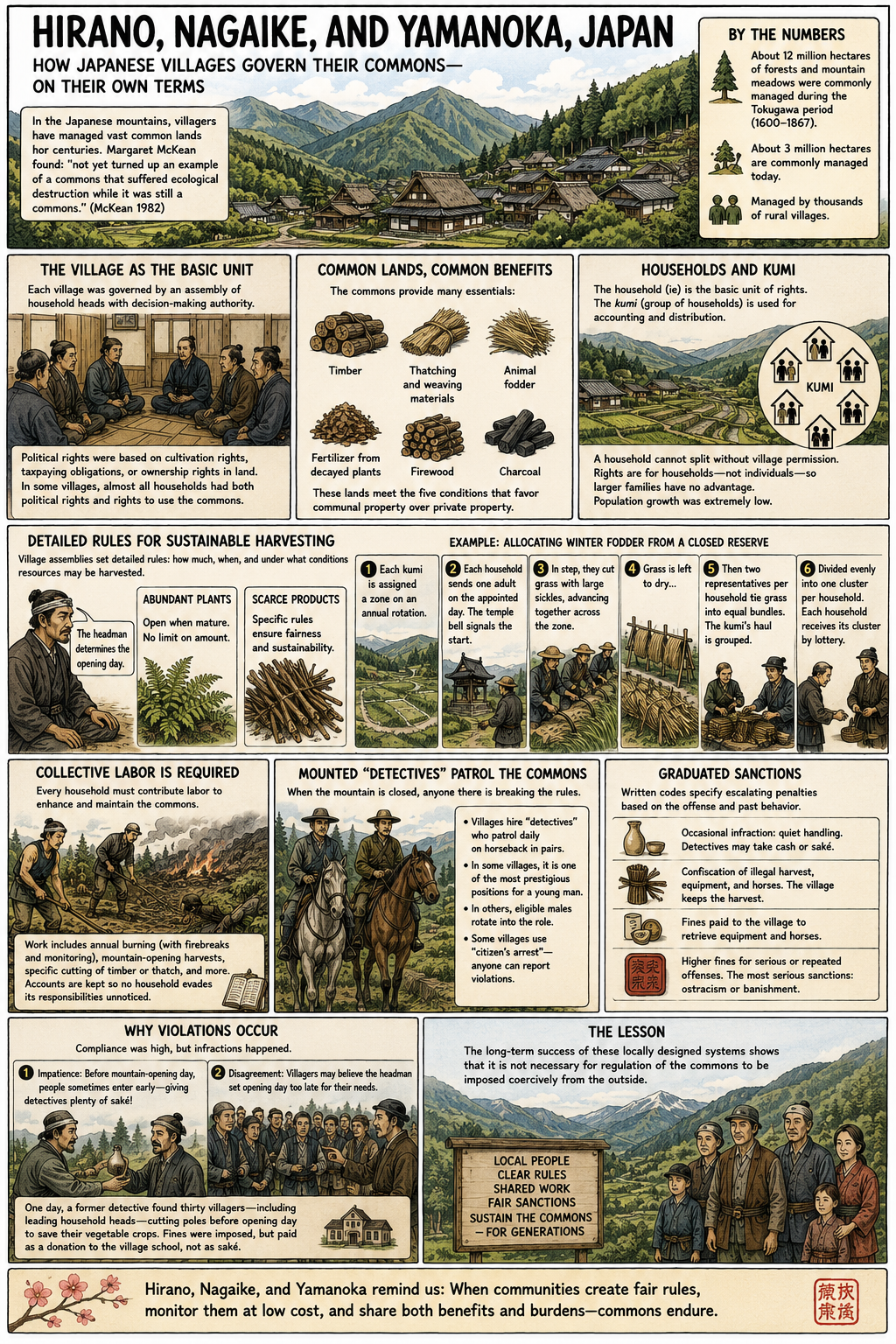
Hirano, Nagaike, and Yamanoka, Japan: household-based rights, detailed harvesting rules, low-cost monitoring, and graduated sanctions.
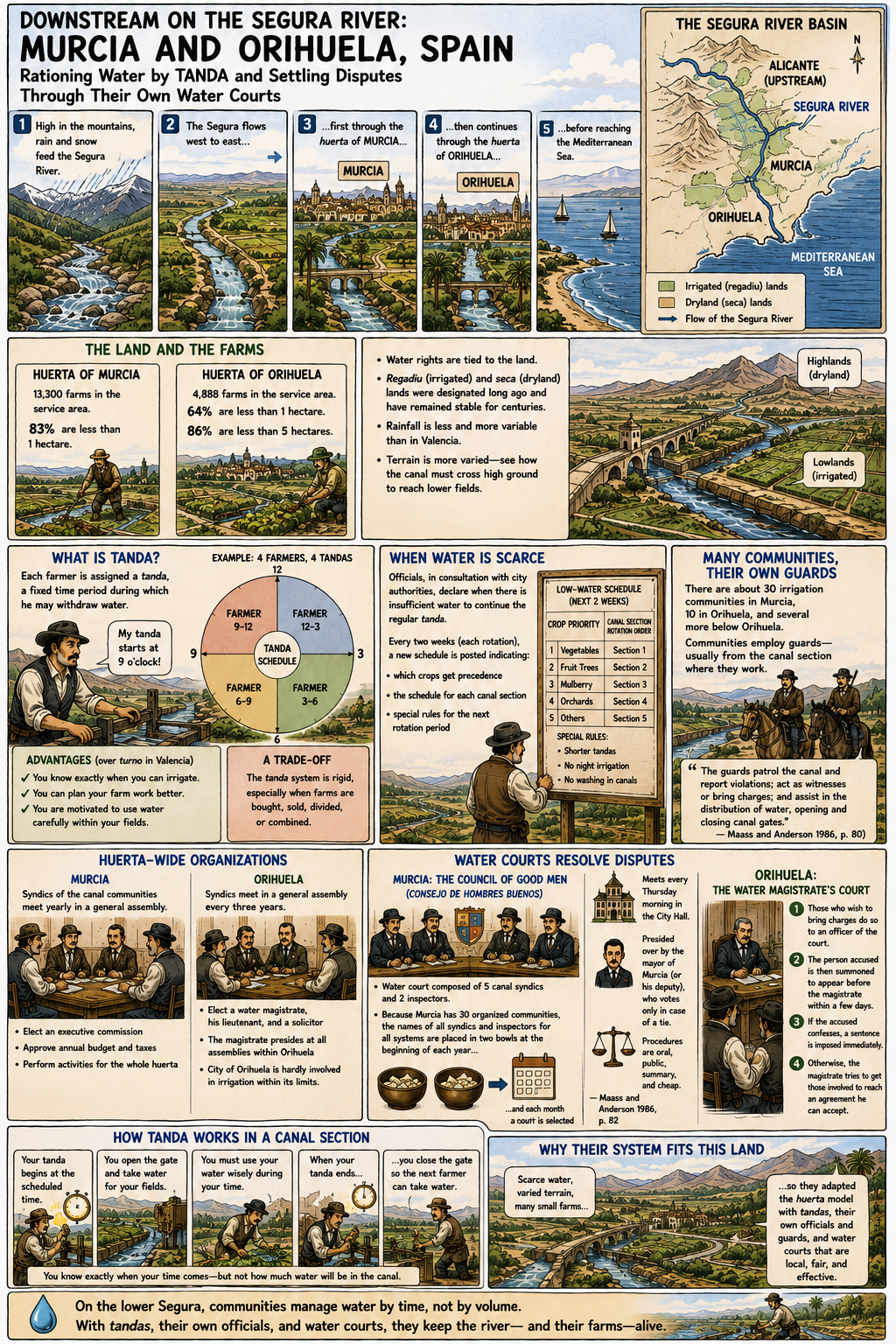
Murcia and Orihuela, Spain: locally fitted water rotations, community guards, and accessible water courts.
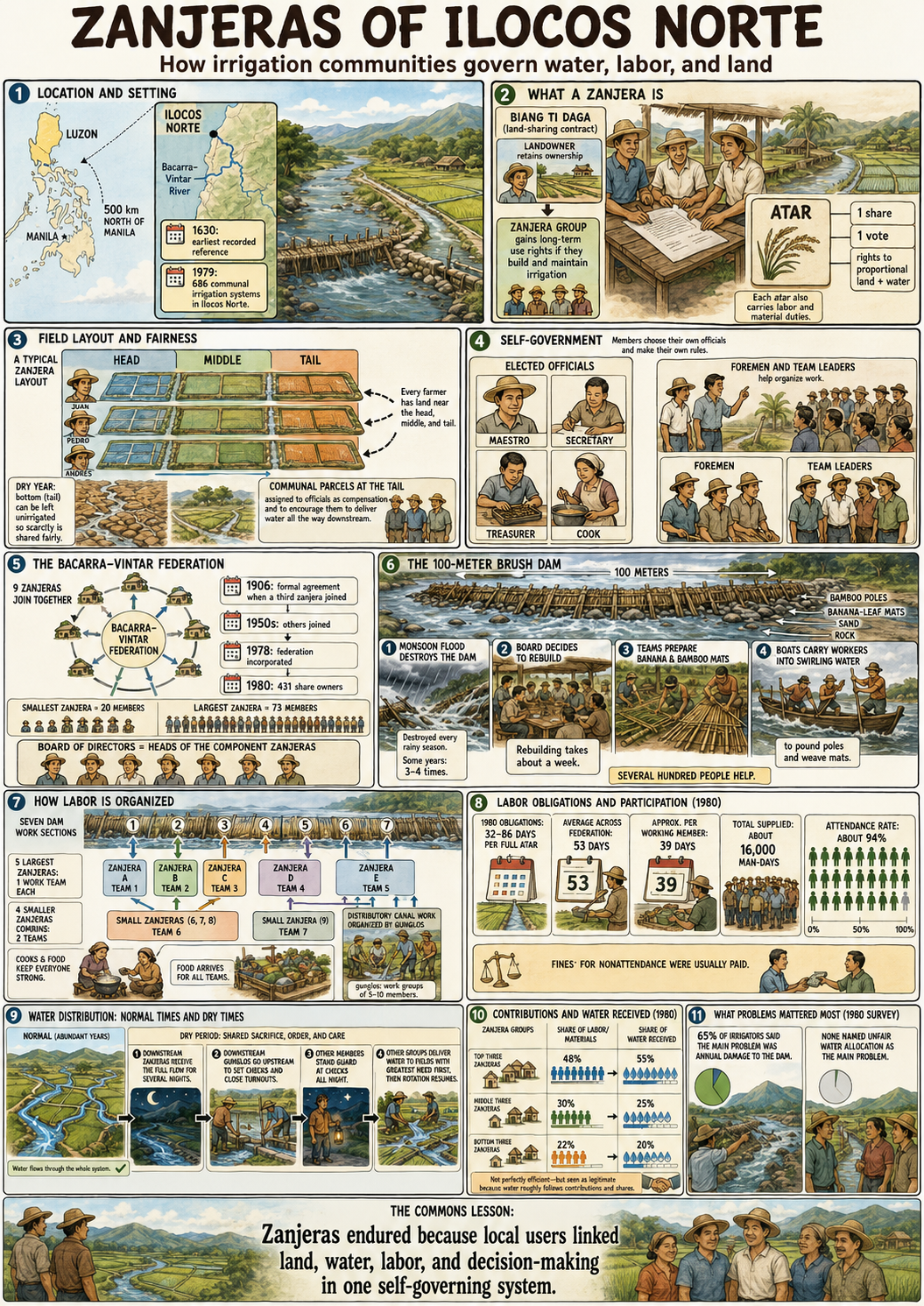
Zanjeras of Ilocos Norte, the Philippines: linked shares of land, water, labor, and decision-making in a nested federation.
B. Institutional Transformation (Step-by-Step Success)
These cases prove that communities can overcome an active “tragedy of the commons” (in this case, an open-access pumping race) by incrementally inventing entirely new institutions.
| Location & Resource | How the Principles Ensured Success |
|---|---|
| Los Angeles Basins(Raymond, West, Central Groundwater) | Pumpers in these basins faced a disastrous open-access race to the bottom, exacerbated by confusing California water laws. They didn’t solve this overnight. First, they formed voluntary associations to fund a geologic survey, creating a shared, trusted image of the actual resource depletion. Then, they used litigation strategically. Suing each other changed the “default rule”: if they didn’t negotiate, a judge would blindly impose a solution. Forced to the table, they negotiated “mutual prescription”—a fair, proportional cutback based on everyone’s historical pumping. To enforce this, they established a neutral, court-appointed watermaster (solving the monitoring problem). Finally, they nested their governance by creating overlapping public districts to tax pumping and buy imported replenishment water. It was a slow, incremental, polycentric success. |
C. Failures and Fragilities
These cases prove that missing even one or two key design principles can cause an entire resource system to collapse.
| Location & Resource | The Missing Principles Leading to Failure / Fragility |
|---|---|
| Bodrum & Bay of Izmir, Turkey(Fisheries) | No Collective Choice or Boundaries (Failure): These fisheries suffered extreme overcrowding and rent dissipation. The groups were too large and heterogeneous (local small boats vs. heavily subsidized commercial trawlers) to find common ground. Because they lacked both physical boundaries and a recognized collective-choice arena to negotiate rules, they were trapped in an unresolvable Tragedy of the Commons. |
| Mojave Basin, California(Groundwater) | Lack of Nesting / Scale Mismatch (Failure): Unlike the successful Los Angeles cases, the Mojave pumpers tried to impose a massive, regional macro-solution across an underground river and 15 distinct sub-basins all at once. They skipped the hard, incremental work of building nested, face-to-face enterprises at the local level first. Because they lacked a shared, agreed-upon image of the problem, the regional effort collapsed into endless political infighting and zero conservation. |
| Mawelle, Sri Lanka(Fishery) | No External Recognition (Failure): The village had an incredibly sophisticated rotation system for allocating net turns (solving the assignment problem). However, when the fishery became highly profitable, wealthy outsiders wanted in. When local fishers tried to enforce limits, the outsiders simply went to sympathetic national politicians who issued them licenses anyway. Because the central government refused to recognize local rules (violating Principle 7), it provided a political escape hatch for cheaters, completely destroying the local institution’s credibility and leading to severe overfishing. |
| Kirindi Oya, Sri Lanka(Irrigation) | No Collective Choice or Monitoring (Failure): A top-down, rigid bureaucracy gave local farmers no collective-choice power over their water. Distant, underpaid engineers couldn’t effectively monitor the massive system, leading to a total lack of enforcement. When enforcement drops to zero, the dominant rational strategy for any farmer is to steal water to flood their fields (saving on weeding labor). This created a vicious cycle of defection and a “hydrologic nightmare.” |
| Gal Oya, Sri Lanka(Irrigation) | Saved by Nesting (Turnaround/Fragile): Originally a massive failure similar to Kirindi Oya, this system was turned around by external “institutional organizers.” Crucially, these organizers didn’t impose a blueprint. They started by helping 10-15 farmers solve small, immediate problems on a single field channel. Once trust and collective-choice worked at that micro-level, they nested these groups upward into larger councils. It remains fragile, however, because it depends entirely on the central government continuing to respect local input. |
| Port Lameron, Nova Scotia(Fishery) | No External Recognition (Fragile): The local fishers have incredible, locally fitted rules detailing exactly which technologies can be used in specific micro-environments. However, the Canadian federal government treats the ocean as entirely open-access and prefers uniform, top-down regulations. The system is highly fragile because the federal government refuses to recognize local boundaries (violating Principle 7), constantly threatening to undermine the locals by letting licensed outsiders in. |
| Alanya, Turkey(Fishery) | Assignment vs. Entry (Success but Fragile): Fishers draw lots and rotate fishing spots daily. This beautifully solves the immediate problem of fighting over the best spots. However, it is fragile because they lack an institution to legally cap the total number of fishers (boundaries) who can join the lottery in the future. If the fishery becomes more profitable, overcrowding could easily destroy it. |
5. How and Why Communities Change Their Rules
A. The Flaws of Human Judgment
First, analysts must realize that people in the real world are not perfect, mindless calculators (like theoretical firms maximizing profit in a textbook market). When deciding whether to change rules, humans are subject to cognitive biases:
-
Loss Aversion: People weight the threat of future loss far more heavily than the promise of future gains. They are much more likely to agree to restrictive rules if they believe a “crisis” is imminent.
-
Recency Bias: People struggle to calculate long-term probabilities. They weight recent events (like a severe drought last year) much more heavily than distant historical data.
B. The Incremental Nature of Change
Creating institutions is almost never one massive, expensive leap from “no rules” to “perfect rules.” It is an incremental, sequential, and self-transforming process. Groups start by making small, cheap changes (like forming a voluntary association just to talk). Once that small change yields a benefit (like sharing the cost of a geologic survey), it transforms their bargaining positions and lowers the cost of the next, slightly larger rule change.
C. Calculating the Decision
Users will decide to change their rules if the Expected Benefits of the new rules outweigh the Transformation Costs and the Monitoring/Enforcement Costs, all filtered through the community’s Internal Norms and Discount Rates. Ostrom identifies specific situational variables that dictate these factors:
1. Evaluating Benefits (Is it worth doing?)
It is very hard for users to estimate the benefits of a new rule. They are more likely to perceive clear benefits if:
-
The resource system is small and predictable (rather than massive and highly variable).
-
There are clear, reliable indicators of resource degradation (activating their loss aversion).
-
Accurate, shared data is available (like the geological surveys in the LA Groundwater cases).
-
Market prices for the resource are relatively stable.
2. Evaluating Transformation Costs (How hard is it to change the rules?)
Creating a new institution is expensive in terms of time, legal fees, and political capital. Costs are lower if:
-
The group of appropriators is relatively small and their interests are homogeneous.
-
The “rules for changing rules” are accessible (e.g., it is easy to call a vote).
-
The External Political Regime allows local autonomy. If the central government is corrupt, or requires massive bureaucratic hurdles just to approve a local rule, the transformation costs become too high for the community to bear.
3. Evaluating Monitoring and Enforcement Costs (How hard is it to catch cheaters?)
Even a perfect rule is useless if it costs too much to enforce. Enforcement costs are lower if:
-
The resource has clear physical boundaries (it’s easier to patrol an enclosed lagoon than the open ocean).
-
The appropriation technology leaves obvious traces.
-
The proposed rules make monitoring a natural byproduct of daily work (like sequential irrigation turns).
-
The External Political Regime recognizes local authority. If the national government refuses to recognize local rules (as in Nova Scotia), locals have to spend massive amounts of energy fighting off legally protected outsiders, driving enforcement costs through the roof.
4. Internal Norms and Discount Rates (Do we care about the future?)
-
Discount Rates: If users plan to live near the resource forever and pass it to their children, they have a low discount rate (they value the future highly) and are willing to suffer short-term costs to save the resource. If they expect to switch professions, they have a high discount rate and will just extract as much as possible right now.
-
Shared Norms: If a community has a deep cultural expectation of reciprocity and trust, the cost of negotiating and monitoring drops significantly because people trust that handshake agreements will be honored.